Safe Life Home Health Care
Program Manager, Clinical Outcomes Research & Care Delivery Innovation · September 2023 to present · Chicago and Lombard, Illinois
I lead applied research and service-delivery improvement for a Medicare-certified provider serving a 450+ average daily census. My work connects clinical outcomes, utilization, clinician workflow, care coordination, conditions in the home, and resource use. The purpose is practical: identify where care is losing value, implement a change, measure what happens, and use the result to improve the next version of the service.
The care-delivery problem
Home-health outcomes depend on more than the clinical plan. A missed handoff, an unresolved fall hazard, an untested private well, incomplete documentation, delayed follow-up, or unclear ownership can interrupt care. I redesigned the delivery model so these conditions could be documented consistently, routed to the right person, and followed through to closure.
How I study and improve delivery
- 1Define the outcome and workflowIdentify the quality, hospitalization, utilization, timeliness, or coordination measure that needs attention and map the steps that produce it.
- 2Examine the baselineCombine clinical, operational, documentation, and home-environment data to locate variation, missed handoffs, and recurring bottlenecks.
- 3Design the interventionBuild or revise the clinical pathway, assessment, technology, staffing rule, or coordination process most likely to address the problem.
- 4Implement with the care teamTrain users, clarify ownership, monitor adoption, and resolve problems that appear in actual visits.
- 5Measure and updateReview outcomes and workflow measures, then retain, revise, or investigate the intervention further.
SafeLife Context
SafeLife Context
Home-environment assessment and care-coordination app
Turning conditions inside the home into structured clinical context the care team can act on.
SafeLife Context is the clinician-facing home-environment assessment and care-coordination app I developed. During a home visit, clinicians document observations and supporting photographs, review AI-flagged visible conditions, confirm or dismiss each suggestion, classify confirmed findings as high, medium, or low risk, assign an owner and due date, and track each item through resolution, improvement, escalation, or continued follow-up. The result is a shared record that carries an environmental finding from the home visit into the plan of care.
The structured assessment covers drinking-water access and private wells, sanitation, visible dampness and mold indicators, ventilation, fall and infection hazards, electrical and power continuity, medication storage, accessibility, and other environmental conditions relevant to care. Conditions that cannot be established from a photograph, including lead, asbestos, radon, microbial contamination, mold species, and drinking-water safety, are routed through history, records review, clinician assessment, or professional testing.
SafeLife Context in action
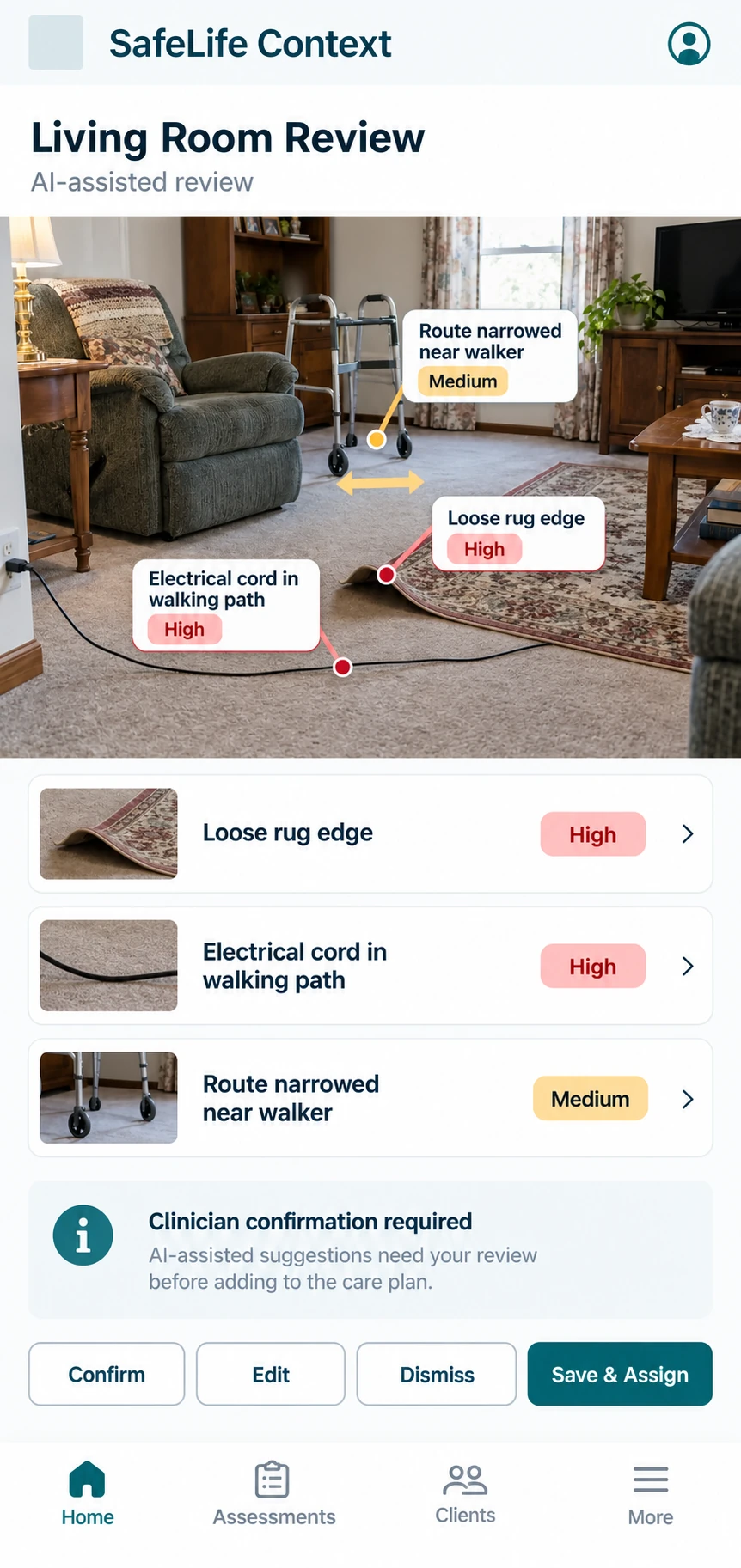
Review visible conditions
- Loose rug edgeHigh
- Electrical cord in walking pathHigh
- Route narrowed near walkerMedium
Clinician actionsConfirmEditDismissSave & Assign
The photograph, the suggestions and the decision sit in one workflow. Nothing enters the care plan until a clinician confirms it.
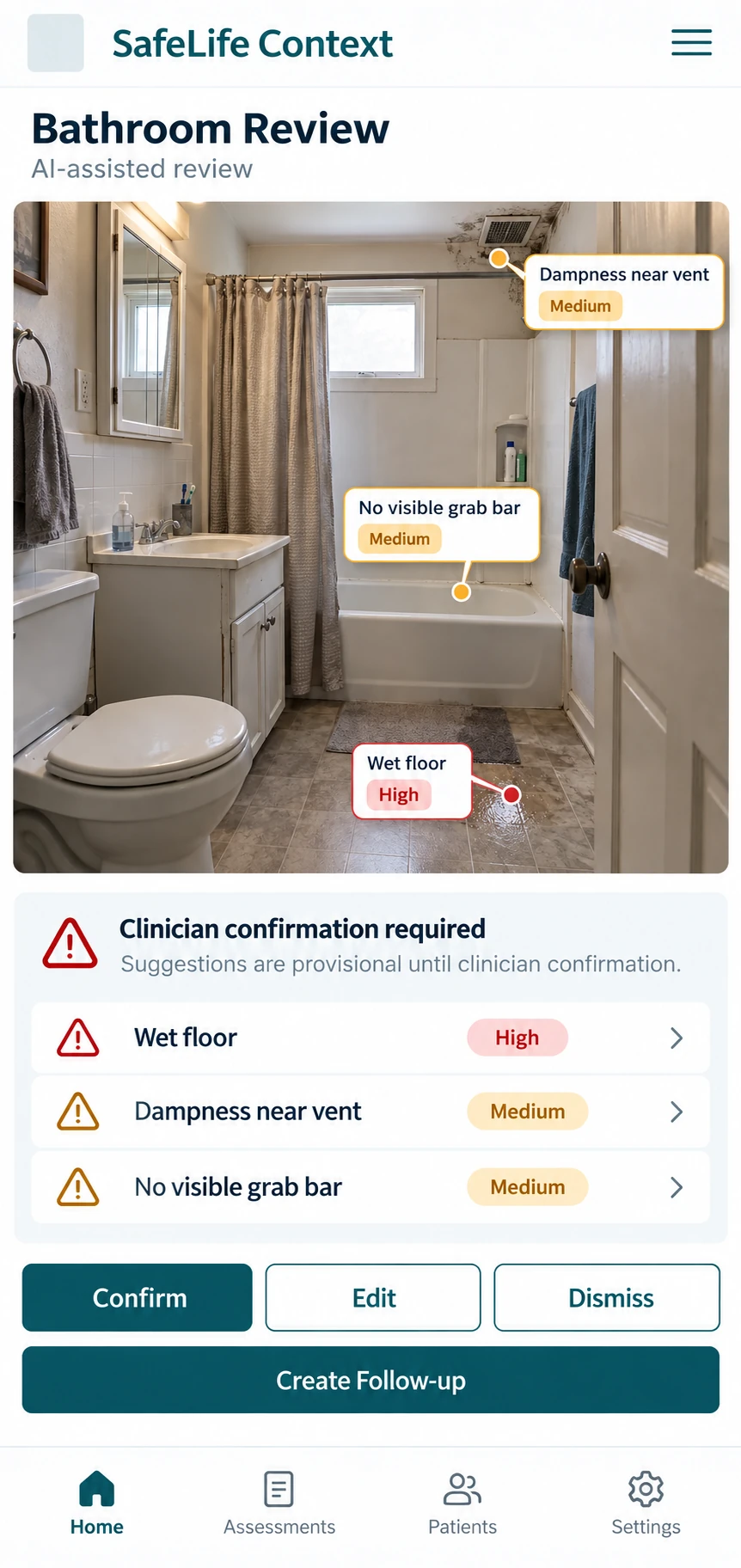
Separate what is visible from what needs testing
- Wet floorHigh
- Dampness near ventMedium
- No visible grab barMedium
Clinician actionsConfirmEditDismissCreate Follow-up
A photograph can show dampness. It cannot identify a mold species, and the app does not claim to. That finding routes to history, records review, or professional testing.
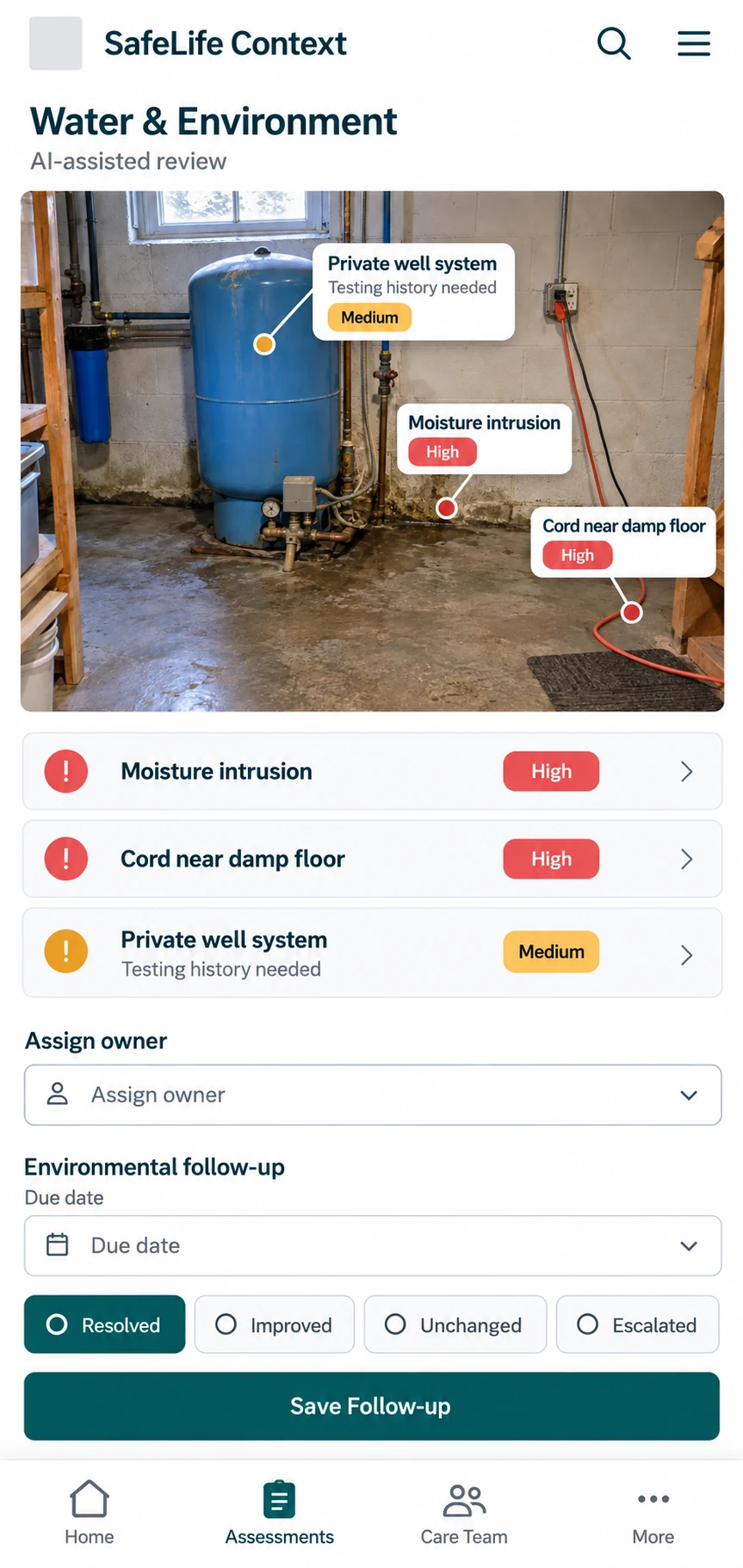
Assign the finding and close the loop
- Moisture intrusionHigh
- Cord near damp floorHigh
- Private well, testing history neededMedium
Clinician actionsResolvedImprovedUnchangedEscalatedSave Follow-up
Every confirmed finding gets an owner, a due date and a recorded outcome. Anything still open returns to the next visit brief.
Representative screens shown with demonstration data and staged home scenes.
Andy-AI and shared care coordination
I led implementation of Andy-AI ambient clinical documentation and connected it with the broader care-coordination workflow. Clinicians reported saving an average of eight hours per week after rollout, reducing documentation burden and returning time to direct patient care. The shared platform also standardized handoffs, escalation, task ownership, acknowledgement, and closure among clinicians, schedulers, and support teams.
Scale and adoption
450+Average daily census served by the care-delivery system
5Specialty areas with diagnosis-led clinical pathways
2,100+Home-environment evaluations completed through the clinician workflow
3Additional healthcare providers adopted the assessment approach
8 hrsPer clinician per week returned from documentation to care after the Andy-AI rollout, on average
Outcomes during the care-delivery redesign
2.5 to 4.5Improvement in the agency’s Quality of Care rating
16% to under 8%Reduction in the agency’s rehospitalization rate
The quality and rehospitalization results occurred during the coordinated redesign of clinical pathways, triage, staffing, documentation, care coordination, environmental assessment, and follow-up. I used these measures to identify which workflows to retain, revise, or investigate further.
What this work taught me
An intervention creates value only when it reaches the user, fits the operating environment, and improves through measurement. At Safe Life, that means connecting conditions in the home, clinician workflow, care coordination, quality outcomes, and resource use in one continuous learning loop.