Hollow fiber membrane for filtration of liquids
Three granted patents on the hollow-fiber membrane innovation, an intrinsically antimicrobial hollow fiber membrane: two US patents and one European patent. The US patents were granted 19 October 2021 and 26 July 2022, and the European patent 5 July 2023. Inventors Shayan Sohail, Arslan Ahmed and Hafiz Usama Tanveer; assignee Pak Vitae (Private) Limited, Lahore.
The invention
A hollow fiber is a polymer tube about the width of a hair, with a wall that is a porous membrane. Water is pushed through the wall from the outside in, and anything larger than the pores, bacteria included, stays outside. Bundle a few thousand fibers into a cartridge and there is enough membrane area that gravity alone, a bucket a meter above the tap, supplies the pressure. No pump, so no electricity.
The new part is what the fiber is made of. Zinc, zinc oxide or a zinc salt is mixed into the polymer before the fiber is spun, so the antimicrobial property is part of the material rather than a coating added afterwards. That matters for two reasons. A filter that sits in a household for a year and a half between anyone looking at it has to resist growing its own biofilm. And whatever kills the microbes must not end up in the drinking water. The patent includes the experiment that shows the difference. A material impregnated with silver nanoparticles leaches them into the surrounding culture and kills bacteria at a distance. The fiber of the invention only inhibits growth at its own surface, because the zinc does not leave the polymer.
The claimed fibers are polyethersulfone with polyvinylpyrrolidone and polyethylene glycol, 80 to 90 percent porous by volume, and cleaned by washing rather than replaced. In the tests reported they reduced E. coli and Staphylococcus by 99.9 percent.
The material
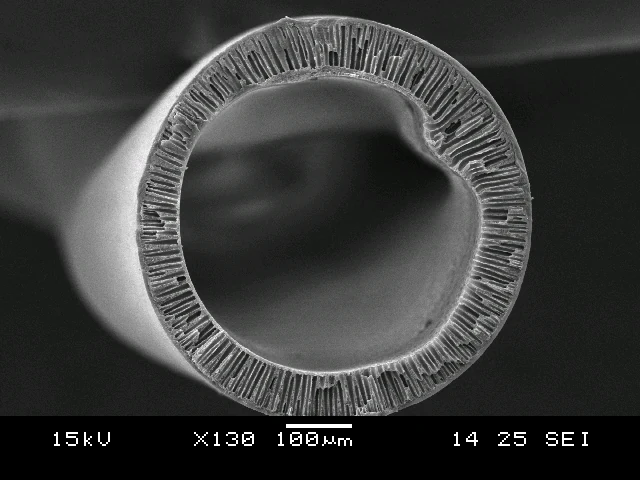
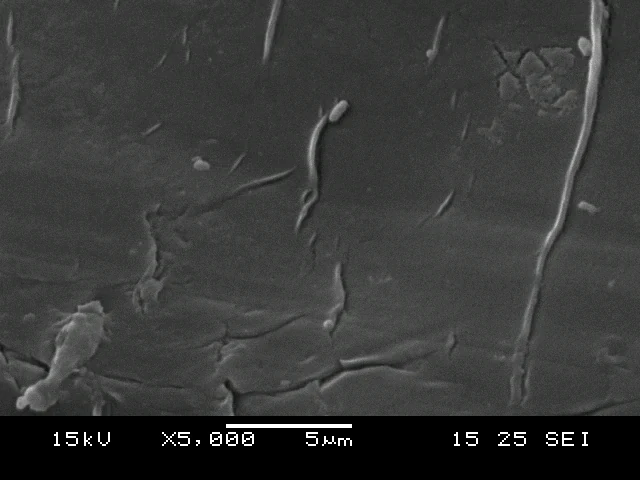
EveryWater micrographs at 15 kV. More on the venture page.